Most people don't think twice about their dish detergent. You grab a bottle, you pour, you move on. But if you're reading this, something on our packaging made you pause, and we think that's worth rewarding with a straight answer.
Here's the full story on Elcove dishwasher tablets: what's in them, how they work, and why we made every decision the way we did.
The Problem With Conventional Dish Detergent
Walk down any cleaning aisle and you'll find rows of jugs and bottles, most of which are 85 to 95 percent water. You're paying to ship water to a store, paying to carry water home, and then throwing away a thick plastic container that will outlast everyone in your household by centuries.
This isn't a legacy format that nobody's gotten around to fixing. It's a business model. Filler is cheap. Plastic is cheap. Convincing consumers that more volume means more power is easy.
Elcove exists because we believe that's a bad deal, and we built our tablets to be the alternative.
One Tablet Does the Work of an Entire Bottle
Elcove tablets are ultra-concentrated. Every ingredient in the formula is there because it contributes to cleaning performance, not to add weight, improve pour consistency, or hit a price point. There's no water content to dilute the actives, no unnecessary filler, and no padding.
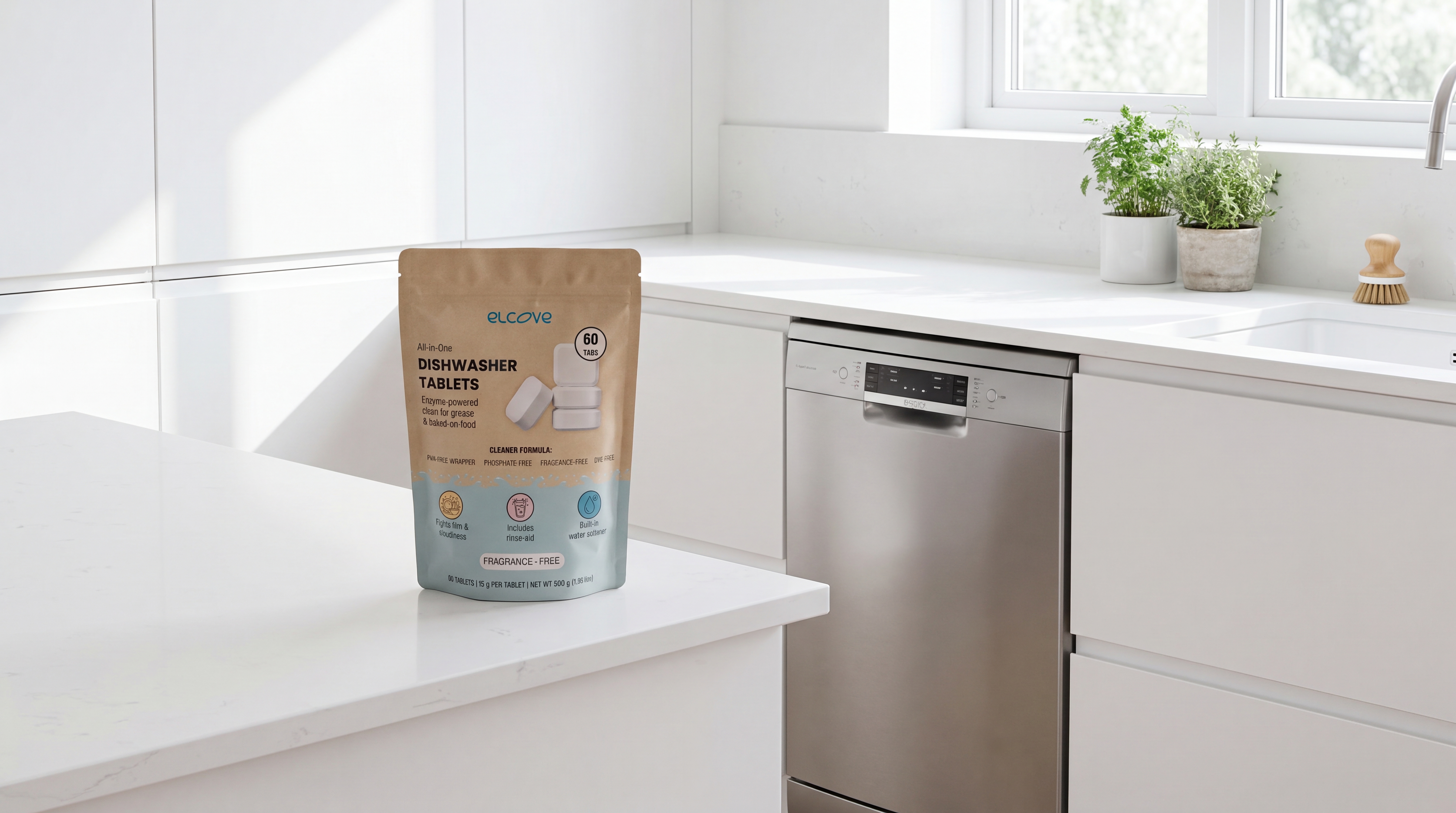
A single tablet contains everything your dishwasher needs for one full cycle. Sixty tablets fit in one compact bag. That bag is smaller, lighter, and easier to store than the collection of plastic bottles it replaces.
What About Other Tablets?
You've probably seen dishwasher tablets or pods before. They've been around for years, and on the surface they solve the plastic bottle problem. So what's actually different about Elcove?
Quite a bit, as it turns out.
Most dishwasher tablets on the market contain only detergent. That's one piece of what your dishwasher actually needs to do its job properly. For spot-free, streak-free results, you also need rinse aid — the product that prevents water droplets from drying into spots on glassware and dishes. And if you live in an area with hard water (which is most of the United States), you also need a water softener to prevent limescale buildup on your dishes and inside your machine over time.
That means buying, storing, and refilling three separate products. Three separate purchases. Three separate things that can run out at different times.
Elcove tablets are all-in-one. Detergent, rinse aid, and water softener are built into every single tablet. You put one tablet in the dispenser, run your cycle, and get genuinely clean, spot-free, residue-free dishes without maintaining a lineup of bottles and dispensers on top of your machine. It's not a compromise formula where each function is diluted to make room for the others. Each component is dosed to perform.
Pre-Measured, Every Time
One of the most overlooked sources of cleaning waste is overdosing. With liquid detergent, it's nearly impossible to know how much is enough, so most people pour more than they need. That excess goes down the drain, into waterways, without doing any useful work. The same applies to separate rinse aid and softener dispensers, which are notoriously easy to overfill.
Our tablet eliminates that entirely. It's better for your dishes, better for your plumbing, and better for the water supply.
The Cleaning Formula Itself
The tablet formula is built around a concentrated enzyme blend designed to break down the three main categories of dishwasher soils: grease and oils, starchy residues, and protein-based food. No artificial dyes. No unnecessary fragrance. No filler ingredients that make a formula look more impressive on the shelf without contributing anything inside the machine.
Now, About the Wrapper
Dissolvable tablet wrappers have attracted real scrutiny in recent years, and the concern is legitimate. Most conventional dishwasher tablets use PVA — polyvinyl alcohol — which is a synthetic plastic polymer. Studies have raised questions about whether PVA fully breaks down under real-world wastewater conditions, which is a reasonable thing to worry about.
We don't use PVA.
Elcove tablets are wrapped in pharmaceutical-grade povidone. It appears in the FDA's Inactive Ingredient Database, it's listed in the US and European pharmacopoeia standards, and it shows up in everything from throat lozenges to contact lens solutions.
We chose it over PVA for three reasons. First, it dissolves faster and more completely than PVA, including in cooler water and lower-pressure cycles. Second, it doesn't leave the gooey film or slick residue that PVA wrappers sometimes deposit on dishes and glassware when conditions aren't perfect. Third, its excellent safety profile is thoroughly documented.
It's worth explaining why the wrapper is needed. Elcove tablets are pressed powder. That structure is exactly what makes them powerful and plastic-free, but it also makes them fragile. Without a wrapper, tablets break apart in transit. By the time they reach your door, you'd have a bag of powder and crumbs instead of sixty intact tablets, which means inconsistent dosing, wasted product, and a frustrating experience. The wrapper isn't a design choice we made for convenience. It's a functional requirement that protects the integrity of every tablet from the moment it's made until it hits your dishwasher.
One bag. No bottle. Nothing hidden.
That's the whole idea.